
CDM College Health Education Series
What is an Ankle Ligament Injury?
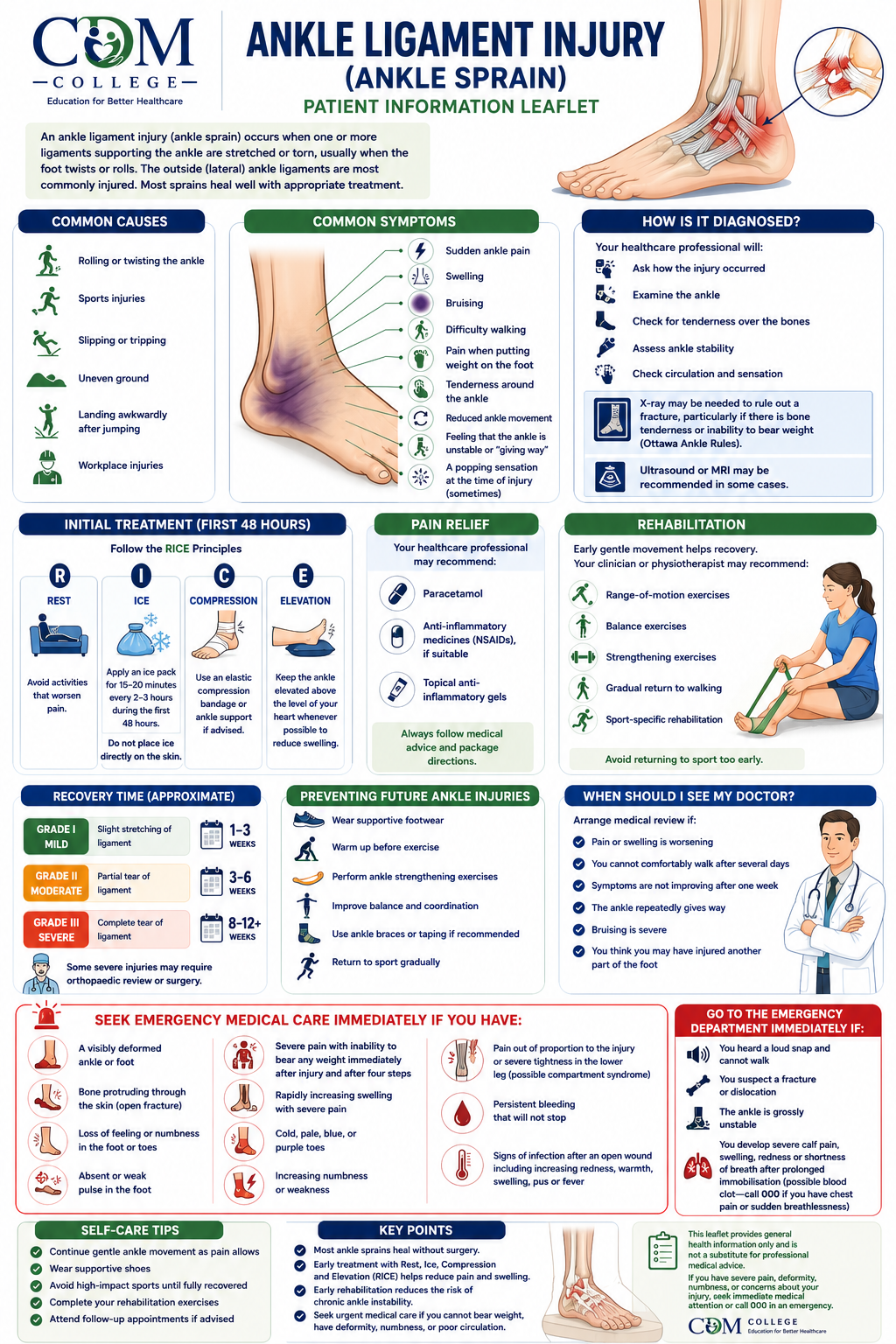
An ankle ligament injury, commonly called an ankle sprain, occurs when one or more ligaments supporting the ankle are stretched or torn. This usually happens when the foot twists or rolls unexpectedly.
The lateral (outside) ankle ligaments are the most commonly injured.
Most ankle sprains improve with appropriate treatment, although severe injuries may require specialist assessment or surgery.
Common Causes
- Rolling or twisting the ankle
- Sports injuries
- Slipping or tripping
- Uneven ground
- Landing awkwardly after jumping
- Workplace injuries
Common Symptoms
You may experience:
- Sudden ankle pain
- Swelling around the ankle
- Bruising
- Difficulty walking
- Pain when putting weight on the foot
- Tenderness around the ankle bones
- Reduced ankle movement
- Feeling that the ankle is unstable or “giving way”
- A popping sensation at the time of injury (sometimes)
How is an Ankle Sprain Diagnosed?
Your healthcare professional will:
- Ask how the injury occurred
- Examine the ankle
- Check for tenderness over the bones
- Assess ankle stability
- Check circulation and sensation
Sometimes an X-ray is needed to rule out a fracture, particularly if there is bone tenderness or inability to bear weight (Ottawa Ankle Rules).
In some cases, an ultrasound or MRI may be recommended.
Initial Treatment (First 48 Hours)
Follow the RICE Principles
Rest
Avoid activities that worsen pain.
Ice
Apply an ice pack for 15–20 minutes every 2–3 hours during the first 48 hours.
Do not place ice directly on the skin.
Compression
Use an elastic compression bandage or ankle support if advised.
Elevation
Keep the ankle elevated above the level of your heart whenever possible to reduce swelling.
Pain Relief
Your healthcare professional may recommend:
- Paracetamol
- Anti-inflammatory medicines (NSAIDs), if suitable
- Topical anti-inflammatory gels
Always follow medical advice and package directions.
Rehabilitation
Early gentle movement helps recovery.
Your clinician or physiotherapist may recommend:
- Range-of-motion exercises
- Balance exercises
- Strengthening exercises
- Gradual return to walking
- Sport-specific rehabilitation
Avoid returning to sport too early.
Recovery Time
Mild sprain (Grade I)
Usually 1–3 weeks
Moderate sprain (Grade II)
Usually 3–6 weeks
Severe sprain (Grade III)
Recovery may take 8–12 weeks or longer.
Some severe injuries require orthopaedic review.
Preventing Future Ankle Injuries
- Wear supportive footwear
- Warm up before exercise
- Perform ankle strengthening exercises
- Improve balance and coordination
- Use ankle braces or taping if recommended
- Return to sport gradually
When Should I See My Doctor?
Arrange medical review if:
- Pain or swelling is worsening
- You cannot comfortably walk after several days
- Symptoms are not improving after one week
- The ankle repeatedly gives way
- Bruising is severe
- You think you may have injured another part of the foot
Seek Emergency Medical Care Immediately If You Have:
🚨 A visibly deformed ankle or foot
🚨 Severe pain with inability to bear any weight immediately after injury and after four steps
🚨 Bone protruding through the skin (open fracture)
🚨 Rapidly increasing swelling with severe pain
🚨 Loss of feeling or numbness in the foot or toes
🚨 Cold, pale, blue, or purple toes
🚨 Absent or weak pulse in the foot
🚨 Increasing numbness or weakness
🚨 Pain out of proportion to the injury or severe tightness in the lower leg (possible compartment syndrome)
🚨 Persistent bleeding that will not stop
🚨 Signs of infection after an open wound, including:
- Increasing redness
- Warmth
- Swelling
- Pus
- Fever
Go to the Emergency Department Immediately If:
- You heard a loud snap and cannot walk
- You suspect a fracture or dislocation
- The ankle is grossly unstable
- You develop severe calf pain, swelling, redness or shortness of breath after prolonged immobilisation (possible blood clot—call 000 if you have chest pain or sudden breathlessness)
Self-Care Tips
✔ Continue gentle ankle movement as pain allows
✔ Wear supportive shoes
✔ Avoid high-impact sports until fully recovered
✔ Complete your rehabilitation exercises
✔ Attend follow-up appointments if advised
Help Shape the Future of Healthcare
Your donation enables CDM College to educate healthcare professionals, develop evidence-based learning, support scholarships, and improve the quality of chronic disease care for communities worldwide.
❤️ Donate SecurelyKey Points
- Most ankle sprains heal without surgery.
- Early treatment with Rest, Ice, Compression and Elevation (RICE) helps reduce pain and swelling.
- Early rehabilitation reduces the risk of chronic ankle instability.
- Seek urgent medical care if you cannot bear weight, have deformity, numbness, or poor circulation.
Disclaimer
This leaflet provides general health information only and is not a substitute for professional medical advice. If you have severe pain, deformity, numbness, or concerns about your injury, seek immediate medical attention or call 000 in an emergency.
CDM College
Education for Better Healthcare
Help Shape the Future of Healthcare
Your donation enables CDM College to educate healthcare professionals, develop evidence-based learning, support scholarships, and improve the quality of chronic disease care for communities worldwide.
❤️ Donate Securely
Help Shape the Future of Healthcare
Your donation enables CDM College to educate healthcare professionals, develop evidence-based learning, support scholarships, and improve the quality of chronic disease care for communities worldwide.
❤️ Donate Securely
Leave a Reply