
CDM College Health Education Series
Why Are Neck Exercises Important?
Strong and flexible neck muscles help support your head, improve posture, reduce pain, and decrease the risk of future neck injuries.
These exercises are commonly recommended for:
- Neck pain
- Cervical degenerative disc disease
- Cervical spondylosis
- Poor posture (“Tech Neck”)
- Muscle strain
- Tension headaches
- Recovery after physiotherapy
Always perform exercises slowly and comfortably.
Stop immediately if you develop severe pain, dizziness, numbness, tingling, or weakness.
Before You Begin
✔ Sit or stand with good posture.
✔ Relax your shoulders.
✔ Keep movements slow and controlled.
✔ Breathe normally.
✔ Perform exercises within a pain-free range.
Aim to complete the exercises once or twice daily, unless advised otherwise.
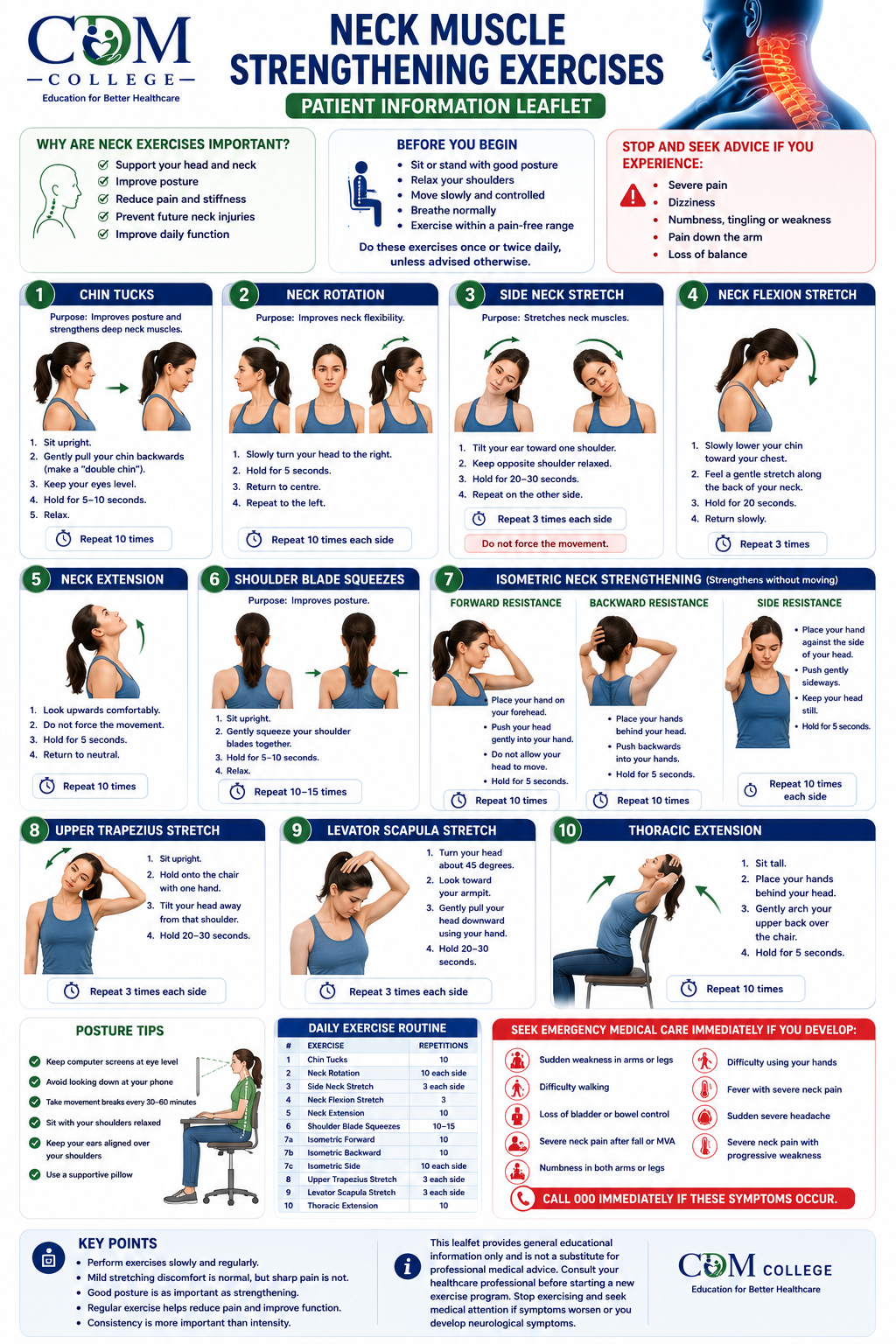
Exercise 1 – Chin Tucks
Purpose: Improves posture and strengthens deep neck muscles.
How to do it:
- Sit upright.
- Look straight ahead.
- Gently pull your chin backwards (make a “double chin”).
- Keep your eyes level.
- Hold for 5–10 seconds.
- Relax.
Repeat 10 times.
Exercise 2 – Neck Rotation
Purpose: Improves neck flexibility.
- Slowly turn your head to the right.
- Hold for 5 seconds.
- Return to centre.
- Repeat to the left.
Repeat 10 times each side.
Exercise 3 – Side Neck Stretch
Purpose: Stretches neck muscles.
- Tilt your ear toward one shoulder.
- Keep your opposite shoulder relaxed.
- Hold for 20–30 seconds.
- Repeat on the other side.
Repeat 3 times each side.
Do not force the movement.
Exercise 4 – Neck Flexion Stretch
- Slowly lower your chin toward your chest.
- Feel a gentle stretch along the back of your neck.
- Hold for 20 seconds.
- Return slowly.
Repeat 3 times.
Exercise 5 – Neck Extension
- Look upwards comfortably.
- Do not force the movement.
- Hold for 5 seconds.
- Return to neutral.
Repeat 10 times.
Exercise 6 – Shoulder Blade Squeezes
Purpose: Improves posture.
- Sit upright.
- Gently squeeze your shoulder blades together.
- Hold for 5–10 seconds.
- Relax.
Repeat 10–15 times.
Exercise 7 – Isometric Neck Strengthening
These exercises strengthen the neck without moving it.
Forward Resistance
Place your hand on your forehead.
Push your head gently into your hand.
Do not allow your head to move.
Hold for 5 seconds.
Repeat 10 times.
Backward Resistance
Place your hands behind your head.
Push backwards into your hands.
Hold 5 seconds.
Repeat 10 times.
Side Resistance
Place your hand against the side of your head.
Push gently sideways.
Keep your head still.
Repeat both sides.
Hold 5 seconds.
Repeat 10 times each side.
Exercise 8 – Upper Trapezius Stretch
- Sit upright.
- Hold onto the chair with one hand.
- Tilt your head away from that shoulder.
- Hold 20–30 seconds.
Repeat 3 times each side.
Exercise 9 – Levator Scapula Stretch
- Turn your head about 45 degrees.
- Look toward your armpit.
- Gently pull your head downward using your hand.
- Hold 20–30 seconds.
Repeat 3 times each side.
Exercise 10 – Thoracic Extension
Improving upper back mobility helps reduce neck strain.
- Sit tall.
- Place your hands behind your head.
- Gently arch your upper back over the chair.
- Hold for 5 seconds.
Repeat 10 times.
Posture Tips
✔ Keep computer screens at eye level.
✔ Avoid looking down at your phone for long periods.
✔ Take movement breaks every 30–60 minutes.
✔ Sit with your shoulders relaxed.
✔ Keep your ears aligned over your shoulders.
✔ Use a supportive pillow.
When Should You Stop Exercising?
Stop immediately and seek medical advice if you develop:
- Increasing neck pain
- Pain shooting into your arm
- New numbness or tingling
- Arm weakness
- Loss of balance
- Dizziness
- Severe headache
- Blurred vision
Seek Emergency Medical Care Immediately If You Develop:
🚨 Sudden weakness in your arms or legs
🚨 Difficulty walking
🚨 Loss of bladder or bowel control
🚨 Severe neck pain following a fall or motor vehicle accident
🚨 Numbness affecting both arms or legs
🚨 Difficulty using your hands
🚨 Fever with severe neck pain
🚨 Sudden severe headache unlike previous headaches
Call 000 immediately if these symptoms occur.
Help Shape the Future of Healthcare
Your donation enables CDM College to educate healthcare professionals, develop evidence-based learning, support scholarships, and improve the quality of chronic disease care for communities worldwide.
❤️ Donate SecurelyKey Points
- Perform exercises slowly and regularly.
- Mild stretching discomfort is normal, but sharp pain is not.
- Good posture is as important as strengthening.
- Regular exercise helps reduce future neck pain and improves long-term function.
- Consistency is more important than intensity.
Daily Exercise Routine
| Exercise | Repetitions |
| Chin Tucks | 10 |
| Neck Rotation | 10 each side |
| Side Stretch | 3 each side |
| Neck Flexion | 3 |
| Neck Extension | 10 |
| Shoulder Blade Squeezes | 10–15 |
| Isometric Forward | 10 |
| Isometric Backward | 10 |
| Isometric Side | 10 each side |
| Upper Trapezius Stretch | 3 each side |
| Levator Scapula Stretch | 3 each side |
| Thoracic Extension | 10 |
Disclaimer
This leaflet provides general educational information only and is not a substitute for professional medical advice. Consult your healthcare professional before starting a new exercise program, especially after an injury or surgery. Stop exercising and seek medical attention if symptoms worsen or you develop neurological symptoms.
CDM College
Education for Better Healthcare
Help Shape the Future of Healthcare
Your donation enables CDM College to educate healthcare professionals, develop evidence-based learning, support scholarships, and improve the quality of chronic disease care for communities worldwide.
❤️ Donate Securely
Help Shape the Future of Healthcare
Your donation enables CDM College to educate healthcare professionals, develop evidence-based learning, support scholarships, and improve the quality of chronic disease care for communities worldwide.
❤️ Donate Securely
Leave a Reply