

CDM College Health Education Series
Oral contraceptive pills are tablets taken to help prevent pregnancy. They may also be prescribed for other reasons, such as heavy periods, painful periods, acne, irregular cycles or hormonal symptoms.
There are two main types:
- Combined oral contraceptive pill — contains oestrogen and progestogen.
- Progestogen-only pill, also called the mini-pill — contains progestogen only.
A doctor, nurse or pharmacist can help decide which option is safest and most suitable for you.
How Do Oral Contraceptive Pills Work?
The pill mainly works by:
- Stopping or reducing ovulation
- Thickening cervical mucus, making it harder for sperm to enter the uterus
- Changing the lining of the uterus so pregnancy is less likely
The pill needs to be taken correctly to work well.
How Effective Is the Pill?
When taken correctly, oral contraceptive pills can be very effective. However, missed pills, vomiting, diarrhoea or some medicines can reduce protection. Better Health Channel notes that oral contraceptive pills can be up to 99% effective with correct use, but mistakes such as forgetting pills can reduce effectiveness.
How to Take the Pill Safely
Take the pill exactly as directed by your doctor, pharmacist or the packet instructions.
General tips:
- Take it at the same time each day
- Set a phone reminder
- Keep a spare strip in your bag if appropriate
- Do not share your pill with friends
- Check what to do if you miss a pill
- Ask about interactions with other medicines
- Attend follow-up checks when recommended
Different pills have different missed-pill rules, so always check the instructions for your specific pill.
What If I Miss a Pill?
If you miss a pill:
- Check the packet instructions immediately
- Take the missed pill as directed
- Use condoms or avoid sex if advised
- Ask a pharmacist, nurse or doctor if unsure
- Ask about emergency contraception if you had unprotected sex
Emergency contraception works best when taken as soon as possible.
Benefits of the Pill
The pill may help with:
- Preventing pregnancy
- More regular periods
- Lighter bleeding
- Less period pain
- Acne in some people
- Premenstrual symptoms in some people
- Managing some hormone-related conditions
The exact benefits depend on the type of pill and the individual person.
Possible Side Effects
Some side effects can happen, especially in the first few months. These may include:
- Nausea
- Headache
- Tender breasts
- Bloating
- Mood changes
- Irregular bleeding or spotting
- Skin changes
- Lower interest in sex
Healthdirect and Better Health Channel list these as possible side effects of contraceptive pills, and many settle after the first few months.
Important Safety Information
The combined pill is not suitable for everyone. You should tell your healthcare provider if you:
- Have migraine with aura
- Have had a blood clot, stroke or heart problem
- Have very high blood pressure
- Smoke or vape nicotine
- Have liver disease
- Have diabetes with complications
- Are very overweight
- Take regular medicines
- Have recently had surgery or prolonged immobility
- Have a family history of blood clots at a young age
The mini-pill may be suitable for some people who cannot take oestrogen, but it still needs to be taken correctly and discussed with a healthcare professional.
The Pill Does Not Protect Against STIs
The pill helps prevent pregnancy, but it does not protect against sexually transmitted infections, including chlamydia, gonorrhoea, syphilis, herpes or HIV.
Use condoms to reduce the risk of STIs. Consider STI testing if you are sexually active, have a new partner, have symptoms, or are worried.
Privacy and Consent
You can speak with a doctor, nurse, pharmacist or sexual health service confidentially. Young people can usually receive confidential healthcare if they are assessed as able to understand the information and decisions involved.
A trusted adult can support you, but you can still ask to speak privately with your healthcare provider.
When to Seek Urgent Medical Help
Seek urgent medical help if you develop:
- Sudden chest pain
- Shortness of breath
- Coughing blood
- Sudden severe headache
- Weakness, numbness or trouble speaking
- Vision changes
- Severe abdominal pain
- Severe leg pain, swelling, redness or warmth
- Fainting or collapse
These symptoms could suggest a serious condition such as a blood clot, stroke or other emergency.
Call Triple Zero (000) immediately in a medical emergency.
Help Shape the Future of Healthcare
Your donation enables CDM College to educate healthcare professionals, develop evidence-based learning, support scholarships, and improve the quality of chronic disease care for communities worldwide.
❤️ Donate SecurelySee a Doctor or Pharmacist If:
Arrange medical advice if:
- You keep missing pills
- You have bleeding that worries you
- You have severe headaches or new migraines
- Your mood changes significantly
- You think you might be pregnant
- You vomit or have severe diarrhoea after taking the pill
- You start new medicines
- You want to change contraception
- You want longer-acting contraception options
The Royal Children’s Hospital explains that young people have several contraception options, including the oral contraceptive pill, vaginal ring, implant, injection, IUDs and condoms.
Key Message
The oral contraceptive pill can be a safe and effective option for many teenage girls when prescribed appropriately and taken correctly. It does not protect against STIs, so condoms and STI testing remain important.
CDM College Health Education Series
Disclaimer
This leaflet provides general health education only. It is not a substitute for medical advice, diagnosis or treatment from your doctor, pharmacist, nurse or qualified healthcare professional.
Always follow the instructions on your specific pill packet and the advice given by your healthcare provider. Seek medical advice if symptoms persist, worsen, or if you are unsure whether the pill is suitable for you.
In an emergency, call Triple Zero (000).
Help Shape the Future of Healthcare
Your donation enables CDM College to educate healthcare professionals, develop evidence-based learning, support scholarships, and improve the quality of chronic disease care for communities worldwide.
❤️ Donate Securely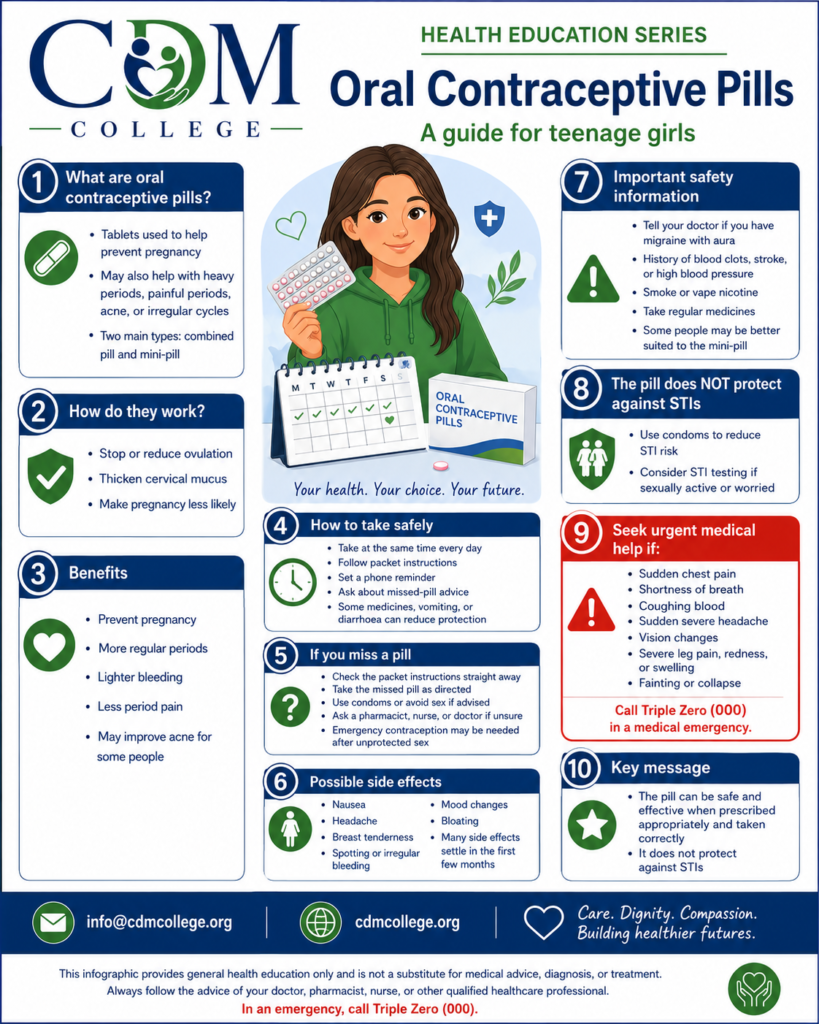
Help Shape the Future of Healthcare
Your donation enables CDM College to educate healthcare professionals, develop evidence-based learning, support scholarships, and improve the quality of chronic disease care for communities worldwide.
❤️ Donate Securely
Leave a Reply