
By CDM College
Shoulder pain is a common complaint affecting people of all ages. Two of the most frequent causes are shoulder tendinopathy and shoulder bursitis, both of which can make everyday activities such as dressing, reaching overhead, or lifting objects uncomfortable.
The good news is that, for most people, a structured exercise program combined with activity modification can significantly improve pain and shoulder function.
Understanding Your Shoulder Pain
What is Shoulder Tendinopathy?
Shoulder tendinopathy occurs when the tendons of the rotator cuff muscles become irritated or overloaded. This commonly develops due to:
- Repetitive overhead activities
- Heavy lifting
- Sports such as swimming or tennis
- Age-related tendon degeneration
Symptoms include:
- Pain when lifting the arm
- Weakness
- Pain at night
- Difficulty reaching overhead
What is Shoulder Bursitis?
A bursa is a small fluid-filled sac that cushions the shoulder joint and reduces friction between tendons and bones.
When inflamed, it can cause:
- Pain around the shoulder
- Tenderness
- Reduced movement
- Difficulty sleeping on the affected side
Bursitis and tendinopathy often occur together.
Before You Start
Exercise Safety
✔ Perform movements slowly and gently.
✔ Mild discomfort during exercise is acceptable.
✖ Stop immediately if you experience:
- Sharp pain
- Sudden loss of strength
- Increasing pain after exercise
- Arm numbness or tingling
Most exercises should be performed once or twice daily.
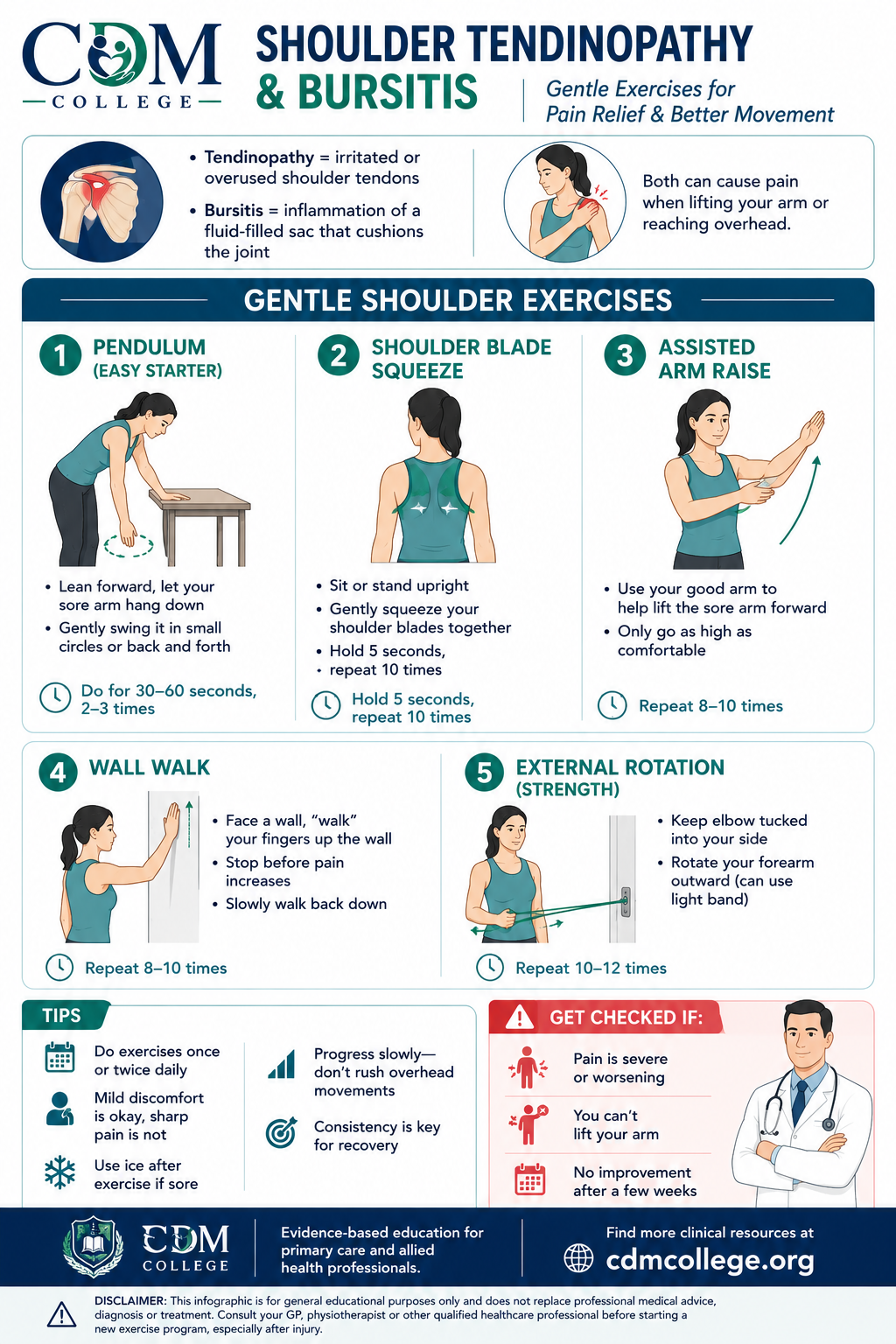
1. Pendulum Exercise
One of the safest exercises during the painful stage.
How to Perform
- Lean forward while supporting yourself with your unaffected arm.
- Allow the sore arm to hang freely.
- Gently swing it:
- Forward and backward
- Side to side
- In small circles
Duration
30–60 seconds
Repeat 2–3 times
Benefits
- Reduces stiffness
- Encourages joint lubrication
- Relaxes shoulder muscles
2. Shoulder Blade Squeeze
Good posture reduces pressure on the shoulder.
How to Perform
- Sit or stand upright.
- Pull your shoulder blades gently backwards.
- Do not shrug your shoulders.
- Hold.
Hold
5 seconds
Repetitions
10 repetitions
Benefits
- Improves posture
- Activates upper back muscles
- Supports shoulder mechanics
3. Assisted Arm Raise
A gentle mobility exercise.
How to Perform
- Hold your affected arm with your good arm.
- Slowly lift the sore arm forwards.
- Only move within a comfortable range.
- Lower slowly.
Repetitions
8–10
Benefits
- Maintains flexibility
- Reduces stiffness
- Improves shoulder movement
4. Wall Walk
Excellent for gradually increasing overhead movement.
How to Perform
- Face a wall.
- Place your fingers on the wall.
- Slowly “walk” your fingers upwards.
- Stop before pain increases.
- Slowly walk back down.
Repetitions
8–10
Benefits
- Improves shoulder mobility
- Builds confidence with overhead movement
5. External Rotation Exercise
Strengthens the rotator cuff.
How to Perform
- Keep your elbow tucked against your side.
- Rotate your forearm outward.
- A light resistance band may be used if comfortable.
- Return slowly.
Repetitions
10–12
Benefits
- Strengthens rotator cuff muscles
- Improves shoulder stability
- Reduces future injury risk
Helpful Tips
- Perform exercises once or twice each day.
- Apply an ice pack for 15–20 minutes after exercise if the shoulder becomes sore.
- Progress gradually—avoid rushing back into overhead activities.
- Maintain good posture throughout the day.
- Continue gentle movement rather than complete rest unless advised otherwise.
Activities to Avoid During Flare-Ups
During painful episodes, try to avoid:
- Heavy lifting
- Repetitive overhead work
- Throwing activities
- Sleeping directly on the affected shoulder
- Sudden jerking movements
Modify activities rather than stopping all movement completely.
When Should You See Your Doctor?
Seek medical assessment if:
- Shoulder pain is severe or rapidly worsening.
- You are unable to lift your arm.
- Pain follows a significant injury or fall.
- You notice swelling, redness, fever, or deformity.
- Symptoms have not improved after 2–6 weeks of appropriate exercises and activity modification.
Key Take-Home Messages
✅ Keep the shoulder moving gently.
✅ Perform exercises consistently.
✅ Mild discomfort is acceptable—sharp pain is not.
✅ Gradually increase movement and strength.
✅ Most people improve with time, exercise, and appropriate activity modification.
Help Shape the Future of Healthcare
Your donation enables CDM College to educate healthcare professionals, develop evidence-based learning, support scholarships, and improve the quality of chronic disease care for communities worldwide.
❤️ Donate SecurelyDisclaimer
This article is intended for general educational purposes only and does not replace advice from your doctor, physiotherapist, or other qualified healthcare professional. These exercises may not be suitable for everyone. Stop exercising if you experience severe pain, increasing weakness, numbness, loss of shoulder movement, or worsening symptoms, and seek prompt medical assessment. Always consult a healthcare professional before starting a new exercise program, particularly after injury or surgery.
References
- National Institute for Health and Care Excellence. Clinical Knowledge Summary: Shoulder Pain.
- American Academy of Orthopaedic Surgeons. Rotator Cuff Tendinitis and Bursitis Patient Education.
- Journal of Orthopaedic & Sports Physical Therapy. Clinical Practice Guidelines: Rotator Cuff Tendinopathy.
- Royal Australian College of General Practitioners. Musculoskeletal conditions in general practice.
- World Health Organization. Rehabilitation in Health Care: Musculoskeletal Conditions.
Help Shape the Future of Healthcare
Your donation enables CDM College to educate healthcare professionals, develop evidence-based learning, support scholarships, and improve the quality of chronic disease care for communities worldwide.
❤️ Donate Securely
Leave a Reply