
By CDM College
Healthy knees are essential for walking, climbing stairs, exercising, and maintaining an active lifestyle. Whether you’re recovering from an injury, managing arthritis, or simply looking to improve knee stability, strengthening the muscles around your knees can help reduce pain, improve function, and lower the risk of future injuries.
This guide introduces safe, evidence-based knee strengthening exercises suitable for most adults.
Why Strengthen Your Knees?
The knee joint relies on strong muscles for support. Strengthening these muscles helps:
✅ Reduce knee pain
✅ Improve stability and balance
✅ Support cartilage and ligaments
✅ Reduce the risk of falls
✅ Improve walking and stair climbing
✅ Enhance sports performance
Muscles That Support the Knee
Effective knee exercises target several important muscle groups:
- Quadriceps (front of the thigh)
- Hamstrings (back of the thigh)
- Gluteal muscles (hips and buttocks)
- Calf muscles
- Hip abductors
- Core muscles
Strong hips and core muscles also improve knee alignment and reduce stress on the joint.
Before You Start
Always:
- Warm up with 5–10 minutes of gentle walking or cycling.
- Wear supportive footwear.
- Perform exercises slowly and with control.
- Stop if you experience sharp or worsening pain.
- Consult a healthcare professional before starting an exercise program if you have recently injured your knee or had surgery.
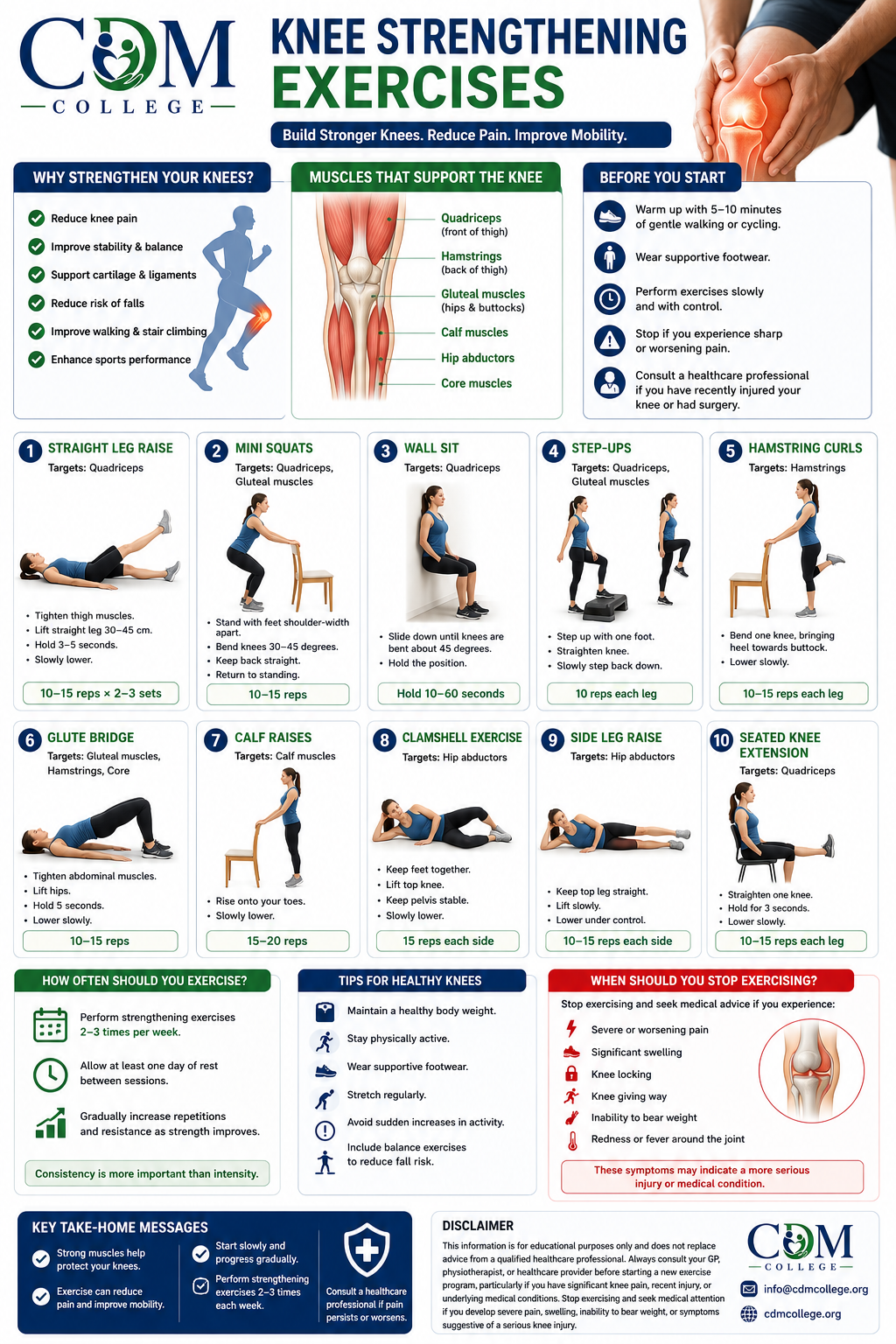
1. Straight Leg Raise
Targets: Quadriceps
How to Perform
- Lie on your back.
- Bend one knee while keeping the other leg straight.
- Tighten the thigh muscles.
- Slowly lift the straight leg about 30–45 cm.
- Hold for 3–5 seconds.
- Slowly lower.
Repeat: 10–15 repetitions × 2–3 sets.
2. Mini Squats
Targets: Quadriceps, gluteal muscles
How to Perform
- Stand with feet shoulder-width apart.
- Hold onto a chair if needed.
- Bend both knees slightly (about 30–45 degrees).
- Keep your back straight.
- Return to standing.
Avoid deep squats if you have knee pain.
Repeat: 10–15 repetitions.
3. Wall Sit
Targets: Quadriceps
How to Perform
- Stand against a wall.
- Slide down until your knees are bent about 45 degrees.
- Hold the position.
Start with 10–20 seconds and gradually increase to 60 seconds.
4. Step-Ups
Targets: Quadriceps, gluteal muscles
How to Perform
- Use a low step.
- Step up with one foot.
- Straighten the knee.
- Slowly step back down.
Repeat: 10 repetitions each leg.
5. Hamstring Curls
Targets: Hamstrings
How to Perform
- Stand while holding onto a chair.
- Bend one knee, bringing your heel towards your buttock.
- Lower slowly.
Repeat: 10–15 repetitions.
6. Glute Bridge
Targets: Gluteal muscles, hamstrings, core
How to Perform
- Lie on your back with knees bent.
- Tighten your abdominal muscles.
- Lift your hips.
- Hold for 5 seconds.
- Lower slowly.
Repeat: 10–15 repetitions.
7. Calf Raises
Targets: Calf muscles
How to Perform
- Stand while holding a chair.
- Rise onto your toes.
- Slowly lower.
Repeat: 15–20 repetitions.
8. Clamshell Exercise
Targets: Hip abductors
How to Perform
- Lie on your side.
- Bend both knees.
- Keep your feet together.
- Lift the top knee while keeping your pelvis stable.
- Slowly lower.
Repeat: 15 repetitions each side.
9. Side Leg Raise
Targets: Hip abductors
How to Perform
- Lie on one side.
- Keep the top leg straight.
- Lift slowly.
- Lower under control.
Repeat: 10–15 repetitions.
10. Seated Knee Extension
Targets: Quadriceps
How to Perform
- Sit in a chair.
- Slowly straighten one knee.
- Hold for 3 seconds.
- Lower slowly.
Repeat: 10–15 repetitions.
How Often Should You Exercise?
For most people:
- Perform strengthening exercises 2–3 times per week.
- Allow at least one day of rest between sessions.
- Gradually increase repetitions and resistance as strength improves.
Consistency is more important than intensity.
Tips for Healthy Knees
- Maintain a healthy body weight.
- Stay physically active.
- Wear supportive footwear.
- Stretch regularly.
- Avoid sudden increases in activity.
- Include balance exercises to reduce fall risk.
When Should You Stop Exercising?
Stop exercising and seek medical advice if you experience:
- Severe or worsening pain
- Significant swelling
- Knee locking
- Knee giving way
- Inability to bear weight
- Redness or fever around the joint
These symptoms may indicate a more serious injury or medical condition.
Key Take-Home Messages
✅ Strong muscles help protect your knees.
✅ Exercise can reduce pain and improve mobility.
✅ Start slowly and progress gradually.
✅ Perform strengthening exercises 2–3 times each week.
✅ Consult a healthcare professional if pain persists or worsens.
Help Shape the Future of Healthcare
Your donation enables CDM College to educate healthcare professionals, develop evidence-based learning, support scholarships, and improve the quality of chronic disease care for communities worldwide.
❤️ Donate SecurelyDisclaimer
This information is intended for educational purposes only and does not replace advice from a qualified healthcare professional. Always consult your GP, physiotherapist, or healthcare provider before starting a new exercise program, particularly if you have significant knee pain, recent injury, or underlying medical conditions. Stop exercising and seek medical attention if you develop severe pain, swelling, inability to bear weight, or symptoms suggestive of a serious knee injury.
References
- American Academy of Orthopaedic Surgeons (AAOS). Knee Conditioning Program.
- Arthritis Foundation. Exercises for Knee Osteoarthritis.
- National Institute for Health and Care Excellence (NICE). Osteoarthritis: Care and Management.
- Royal Australian College of General Practitioners (RACGP). Guideline for the Management of Knee Osteoarthritis.
- American Physical Therapy Association (APTA). Clinical Practice Guidelines for Knee Pain and Osteoarthritis.
Help Shape the Future of Healthcare
Your donation enables CDM College to educate healthcare professionals, develop evidence-based learning, support scholarships, and improve the quality of chronic disease care for communities worldwide.
❤️ Donate Securely
Help Shape the Future of Healthcare
Your donation enables CDM College to educate healthcare professionals, develop evidence-based learning, support scholarships, and improve the quality of chronic disease care for communities worldwide.
❤️ Donate Securely
Leave a Reply