
Understanding Fluoxetine, How It Works, and What to Expect
CDM College Health Education Series
When your child is prescribed a new medication, it is natural to have questions and concerns. Fluoxetine is one of the most commonly prescribed antidepressant medicines for children and adolescents and has been extensively studied for its safety and effectiveness when used appropriately.
This guide explains what fluoxetine is, why it may be prescribed, how it should be taken, possible side effects, and important safety information for parents and caregivers.
What is Fluoxetine?
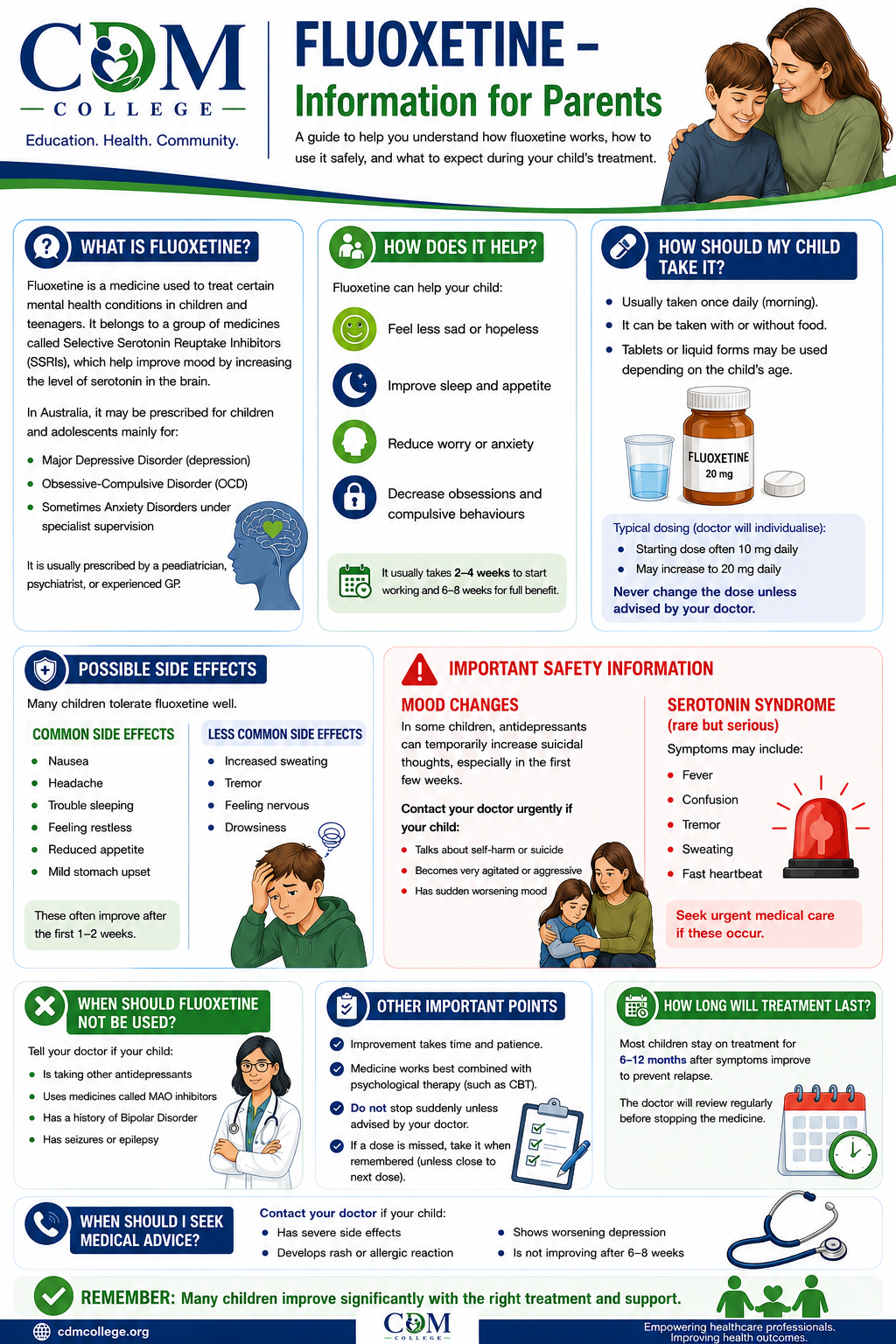
Fluoxetine is a prescription medicine that belongs to a group of medications called Selective Serotonin Reuptake Inhibitors (SSRIs). SSRIs work by increasing the amount of serotonin, a naturally occurring chemical in the brain that helps regulate mood, emotions, sleep, and anxiety.
In Australia, fluoxetine is one of the few antidepressants with evidence supporting its use in children and adolescents when prescribed and monitored by an experienced healthcare professional.
It is commonly prescribed for:
- Major Depressive Disorder (Depression)
- Obsessive-Compulsive Disorder (OCD)
- Some Anxiety Disorders under specialist supervision
Fluoxetine is usually prescribed by a paediatrician, child psychiatrist, or a GP with experience in managing children’s mental health.
How Does Fluoxetine Help?
Fluoxetine helps restore the balance of serotonin in the brain, which may improve emotional wellbeing and reduce symptoms of depression and anxiety.
Many children experience improvements such as:
- Feeling less sad or hopeless
- Improved motivation and energy
- Better sleep
- Improved appetite
- Reduced worry and anxiety
- Fewer obsessive thoughts
- Reduced compulsive behaviours
- Better concentration and participation at school
Fluoxetine does not work immediately.
Most children begin to notice improvement within 2–4 weeks, while the full benefits usually occur after 6–8 weeks.
It is important to continue taking the medication even if improvement is not immediate.
How Should My Child Take Fluoxetine?
Fluoxetine is usually taken:
- Once daily
- Preferably in the morning
- With or without food
- As a capsule, tablet, or liquid depending on age and swallowing ability
Your doctor will decide the most appropriate dose.
Typical dosing may include:
| Age | Typical Starting Dose |
| Children and adolescents | 10 mg once daily |
| Dose may increase | Usually up to 20 mg once daily if required |
Never increase, decrease, or stop the medication without first speaking to your child’s doctor.
What If My Child Misses a Dose?
If your child forgets a dose:
- Give it as soon as you remember.
- If it is close to the next scheduled dose, skip the missed dose.
- Do not give two doses together.
If your child misses several doses, contact your doctor for advice.
Possible Side Effects
Most children tolerate fluoxetine well, particularly after the first few weeks.
Common Side Effects
These often improve after 1–2 weeks:
- Nausea
- Mild stomach upset
- Headache
- Difficulty sleeping
- Feeling restless
- Reduced appetite
- Mild anxiety during the first few days
Less Common Side Effects
Some children may experience:
- Increased sweating
- Tremor or shaking
- Feeling nervous
- Drowsiness
- Dizziness
- Dry mouth
Most side effects are mild and temporary.
Speak to your doctor if they become troublesome or persist.
Important Safety Information
Changes in Mood
During the first few weeks of treatment, a small number of children and teenagers may experience worsening mood or an increase in suicidal thoughts.
Parents should closely monitor their child, particularly during the first month of treatment and after any dose change.
Seek urgent medical advice if your child:
- Talks about death or suicide
- Mentions self-harm
- Becomes unusually aggressive
- Appears extremely restless or agitated
- Shows sudden worsening depression
- Withdraws significantly from family or friends
Although this warning is important, it is also important to remember that untreated depression itself carries a significant risk of self-harm and suicide, and fluoxetine has been shown to be effective for many young people when carefully monitored.
Serotonin Syndrome (Rare but Serious)
Serotonin syndrome is an uncommon but potentially serious reaction that occurs when serotonin levels become excessively high.
Symptoms may include:
- High fever
- Confusion
- Agitation
- Tremor
- Muscle stiffness
- Heavy sweating
- Fast heartbeat
- Diarrhoea
Seek immediate medical attention if these symptoms occur.
When Should Fluoxetine Not Be Used?
Tell your doctor if your child:
- Is taking another antidepressant
- Has recently taken a Monoamine Oxidase Inhibitor (MAOI)
- Has Bipolar Disorder or episodes of mania
- Has epilepsy or seizures
- Has liver disease
- Has bleeding disorders
- Is taking medicines that may interact with fluoxetine
Always tell your doctor about any vitamins, herbal medicines, or over-the-counter medications your child is taking.
Does My Child Still Need Counselling?
Yes.
Research shows that fluoxetine works best when combined with psychological therapy.
Many children benefit from:
- Cognitive Behavioural Therapy (CBT)
- Family therapy
- School-based support
- Counselling
- Healthy sleep routines
- Regular exercise
- Good nutrition
Medication is only one part of successful treatment.
How Long Will Treatment Last?
Most children continue fluoxetine for 6–12 months after symptoms improve to reduce the risk of relapse.
Your child’s doctor will review progress regularly and decide when it is appropriate to gradually stop treatment.
Do not stop fluoxetine suddenly unless advised by your healthcare provider.
Practical Tips for Parents
You can support your child’s recovery by:
- Encouraging regular medication use.
- Attending follow-up appointments.
- Monitoring mood and behaviour.
- Maintaining healthy sleep habits.
- Encouraging regular physical activity.
- Keeping communication open.
- Praising progress, even small improvements.
- Informing teachers if additional support is needed.
Recovery often occurs gradually rather than overnight.
When Should I Contact My Doctor?
Arrange a medical review if your child:
- Experiences troublesome side effects
- Develops a rash or allergic reaction
- Appears increasingly depressed
- Has persistent difficulty sleeping
- Is not improving after 6–8 weeks
- Has concerns about school, eating, or behaviour
Seek Emergency Medical Care Immediately If Your Child:
- Talks about suicide or self-harm
- Has attempted self-harm
- Develops symptoms of serotonin syndrome
- Has seizures
- Becomes severely confused or difficult to wake
Frequently Asked Questions
Will fluoxetine change my child’s personality?
No. Fluoxetine is designed to improve symptoms of depression or anxiety, allowing children to feel more like themselves again.
Is fluoxetine addictive?
No. Fluoxetine is not addictive, although it should not be stopped suddenly without medical advice.
Can my child continue school and sports?
Yes. Most children can continue their normal daily activities while taking fluoxetine.
Key Take-Home Messages
- Fluoxetine is an effective treatment for depression and OCD in many children and adolescents.
- Improvement usually begins within 2–4 weeks, with full benefits often taking 6–8 weeks.
- The medicine works best alongside psychological therapies such as CBT.
- Parents should monitor mood closely during the first few weeks of treatment.
- Never stop or adjust the dose without medical advice.
- Regular follow-up appointments are essential to ensure treatment remains safe and effective.
References
- National Institute for Health and Care Excellence (NICE). Depression in Children and Young People: Identification and Management (NG134). Available at: https://www.nice.org.uk/guidance/ng134
- Royal Australian and New Zealand College of Psychiatrists (RANZCP). Clinical Practice Guidelines for Mood Disorders. Available at: https://www.ranzcp.org
- Beyond Blue. Depression and Anxiety in Young People. Available at: https://www.beyondblue.org.au
- Raising Children Network (Australia). Antidepressant Medicines for Children and Teenagers. Available at: https://raisingchildren.net.au
- Therapeutic Guidelines Limited. Therapeutic Guidelines: Psychotropic. Melbourne, Australia.
- Australian Medicines Handbook (AMH). Fluoxetine Monograph. Adelaide: Australian Medicines Handbook Pty Ltd.
- National Prescribing Service (NPS MedicineWise). Medicines for Depression and Anxiety. Available at: https://www.nps.org.au
- Hetrick SE, McKenzie JE, Bailey AP, et al. New Generation Antidepressants for Depression in Children and Adolescents. Cochrane Database of Systematic Reviews. 2021.
Disclaimer: This article is intended for educational purposes only and should not replace personalised medical advice. Always consult your child’s doctor, paediatrician, or psychiatrist before starting, stopping, or changing any medication. If your child is at immediate risk of self-harm or suicide, call 000 or attend your nearest emergency department immediately.
Help Shape the Future of Healthcare
Your donation enables CDM College to educate healthcare professionals, develop evidence-based learning, support scholarships, and improve the quality of chronic disease care for communities worldwide.
❤️ Donate Securely
Leave a Reply