
By CDM College
Back pain is one of the most common musculoskeletal complaints seen in primary care and allied health settings. Whether caused by muscle strain, degenerative changes, poor posture, prolonged sitting, or age-related wear and tear, exercise remains one of the most effective treatments for most cases of non-specific low back pain.
Research consistently shows that gentle movement, strengthening exercises, and gradual return to activity can reduce pain, improve function, and lower the risk of recurrent episodes.
Why Exercise Helps Back Pain
Appropriate exercises can:
- Improve spinal mobility
- Strengthen the muscles supporting the spine
- Reduce stiffness
- Improve posture
- Increase flexibility
- Reduce recurrence of back pain
- Improve balance and confidence with movement
The key is choosing safe, controlled exercises and progressing gradually.
Safety First
Before starting any exercise program:
Stop exercising immediately if:
- Pain radiates down the leg
- You develop numbness or weakness
- Sharp spinal or joint pain occurs
- Symptoms worsen significantly
Progress slowly
- Begin with 1–2 sets
- Perform exercises slowly
- Increase repetitions only as symptoms improve
If you have severe pain, recent trauma, osteoporosis, cancer, infection, bowel/bladder symptoms, or significant neurological symptoms, seek medical assessment before commencing exercises.
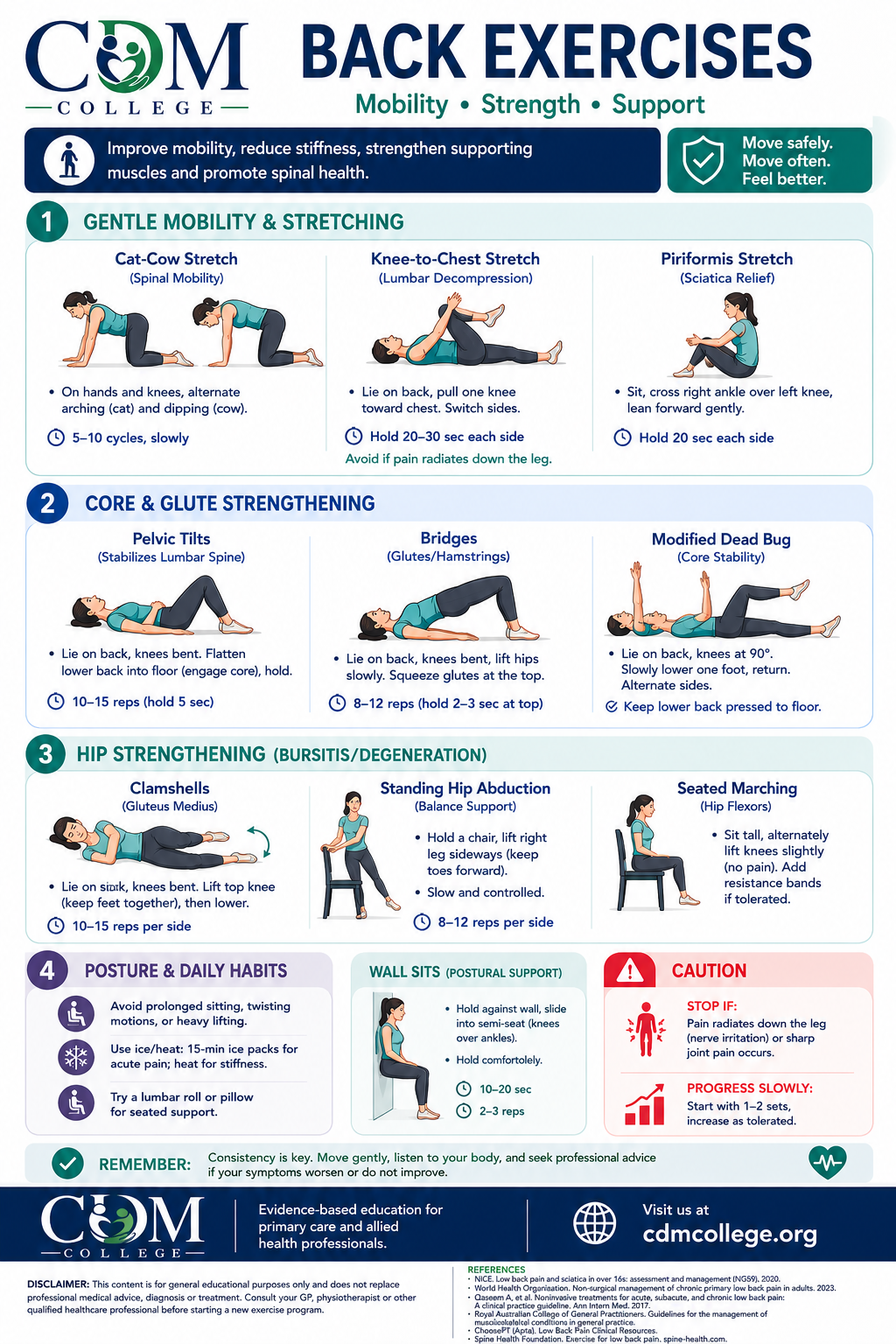
1. Gentle Mobility and Stretching
Cat-Cow Stretch (Spinal Mobility)
How to perform
- Begin on hands and knees
- Slowly arch your back upward (“Cat”)
- Then gently lower your abdomen while lifting your chest (“Cow”)
- Move slowly between both positions
Repetitions
5–10 slow cycles
Benefits
- Improves spinal flexibility
- Reduces lumbar stiffness
- Encourages gentle movement
Knee-to-Chest Stretch (Lumbar Decompression)
How to perform
- Lie on your back
- Bend one knee
- Pull it gently towards your chest
- Hold
- Repeat on the opposite side
Hold
20–30 seconds
Repeat
3–5 times each side
Avoid if
Pain shoots down the leg or symptoms suggest nerve irritation.
Piriformis Stretch
Helpful for patients experiencing buttock tightness or mild sciatic symptoms.
How
- Sit comfortably
- Cross one ankle over the opposite knee
- Lean forward gently
Hold
20 seconds
Repeat on both sides.
Child’s Pose
How
- Kneel on the floor
- Sit back onto your heels
- Stretch your arms forward
- Relax your lower back
Hold
20–30 seconds
Repeat 2–3 times.
2. Core Strengthening
Strong core muscles reduce stress on the lumbar spine.
Pelvic Tilts
How
- Lie on your back
- Knees bent
- Tighten abdominal muscles
- Flatten the lower back into the floor
Hold
5 seconds
Repetitions
10–15
Benefits
- Improves spinal stability
- Activates deep abdominal muscles
Bridges
One of the best exercises for strengthening the gluteal muscles.
How
- Lie on your back
- Knees bent
- Lift hips slowly
- Squeeze the buttocks
- Lower with control
Repetitions
8–12
Hold 2–3 seconds at the top.
Modified Dead Bug
How
- Lie on your back
- Knees bent to 90°
- Slowly lower one foot to tap the floor
- Return and alternate
Keep the lower back gently pressed into the floor throughout.
3. Hip Strengthening
Hip weakness commonly contributes to persistent lower back pain.
Clamshells
Targets the gluteus medius.
How
- Lie on your side
- Knees bent
- Keep feet together
- Lift the upper knee
- Lower slowly
Repetitions
10–15 each side
Standing Hip Abduction
How
- Hold onto a chair
- Lift one leg sideways
- Keep toes pointing forwards
- Return slowly
Repetitions
8–12 each side
Seated Marching
Ideal for beginners.
How
- Sit upright
- Lift one knee
- Alternate slowly
- Progress using resistance bands if appropriate
Side-Lying Leg Raises
Strengthens hip stabilisers.
How
- Lie on one side
- Raise the upper leg slowly
- Hold briefly
- Lower under control
Hold
2–3 seconds
Repetitions
10–15 each side
4. Posture and Daily Habits
Exercise works best when combined with healthy daily habits.
Avoid
- Prolonged sitting
- Heavy lifting
- Twisting while lifting
- Sudden bending movements
- High-impact exercise during painful flare-ups
Helpful strategies
- Stand and stretch every 30–60 minutes
- Use a lumbar support when sitting
- Sleep on a supportive mattress
- Maintain regular walking
- Stay physically active
Wall Sits
Wall sits help strengthen postural muscles.
How
- Stand against a wall
- Slide down slightly
- Keep knees over ankles
- Hold comfortably
Hold
10–20 seconds
Repeat 2–3 times.
Ice or Heat?
Ice
Useful during the first 24–48 hours following an acute flare-up.
Apply for 15 minutes several times daily.
Heat
Useful for:
- Chronic stiffness
- Muscle tightness
- Before exercise
When Should You See a Doctor?
Seek urgent medical attention if back pain is associated with:
- Loss of bladder or bowel control
- Progressive leg weakness
- Fever
- History of significant trauma
- Unexplained weight loss
- History of cancer
- Severe night pain
- Saddle numbness
These may indicate serious spinal pathology requiring immediate assessment.
Key Take-Home Messages
✔ Stay active where possible.
✔ Gentle exercise is generally better than prolonged bed rest.
✔ Build core and hip strength gradually.
✔ Good posture and regular movement reduce recurrence.
✔ Stop if pain worsens or symptoms travel down the leg.
✔ Consult your healthcare professional before starting a new exercise program if you have significant medical conditions.
Help Shape the Future of Healthcare
Your donation enables CDM College to educate healthcare professionals, develop evidence-based learning, support scholarships, and improve the quality of chronic disease care for communities worldwide.
❤️ Donate SecurelyDisclaimer
This article is intended for general educational purposes only and should not replace assessment or treatment by a qualified healthcare professional. Exercise recommendations may not be suitable for everyone. If you experience severe pain, progressive weakness, numbness, bowel or bladder dysfunction, recent trauma, fever, unexplained weight loss, or symptoms that worsen with exercise, seek prompt medical assessment. Always consult your GP, physiotherapist, or other qualified healthcare provider before commencing a new exercise program.
References
- National Institute for Health and Care Excellence. Low Back Pain and Sciatica in Over 16s: Assessment and Management (NG59). 2020 update.
- World Health Organization. WHO Guideline for Non-Surgical Management of Chronic Primary Low Back Pain in Adults. 2023.
- American College of Physicians. Noninvasive Treatments for Acute, Subacute, and Chronic Low Back Pain: A Clinical Practice Guideline.
- Royal Australian College of General Practitioners. Guidelines for the Management of Musculoskeletal Conditions in General Practice.
- ChoosePT. Low Back Pain Clinical Resources.
- Spine Health Foundation. Educational resources on therapeutic exercise for low back pain.
Help Shape the Future of Healthcare
Your donation enables CDM College to educate healthcare professionals, develop evidence-based learning, support scholarships, and improve the quality of chronic disease care for communities worldwide.
❤️ Donate Securely
Help Shape the Future of Healthcare
Your donation enables CDM College to educate healthcare professionals, develop evidence-based learning, support scholarships, and improve the quality of chronic disease care for communities worldwide.
❤️ Donate Securely
Leave a Reply