

Adhesive Capsulitis (Frozen Shoulder): A Complete Patient Guide to Recovery and Home Exercises
CDM College Health Education Series
Adhesive capsulitis, more commonly known as frozen shoulder, is a painful condition that causes stiffness and reduced movement of the shoulder joint. Although recovery can take time, most people improve significantly with the right combination of pain management, gentle exercises, and physiotherapy.
This guide explains what frozen shoulder is, its symptoms, treatment options, and simple home exercises that can help restore shoulder movement.
What is Frozen Shoulder?
Frozen shoulder (adhesive capsulitis) is a condition in which the capsule surrounding the shoulder joint becomes inflamed, thickened, and tight. As the capsule contracts, it restricts movement and causes pain.
Unlike arthritis, frozen shoulder primarily affects the soft tissues surrounding the joint rather than the bones or cartilage.
The condition most commonly affects adults between 40 and 70 years of age and is more frequent in women. People with diabetes, thyroid disorders, Parkinson’s disease, stroke, or prolonged shoulder immobilisation have a higher risk of developing frozen shoulder.
What Causes Frozen Shoulder?
The exact cause is not always known. However, frozen shoulder may develop after:
- Shoulder injury or trauma
- Shoulder surgery
- Rotator cuff disorders
- Prolonged use of a sling
- Diabetes mellitus
- Thyroid disease
- Stroke
- Parkinson’s disease
Sometimes, frozen shoulder develops without an obvious cause.
Common Symptoms
Symptoms usually develop gradually over weeks to months and may include:
- Persistent shoulder pain
- Pain that is often worse at night
- Difficulty sleeping on the affected side
- Progressive stiffness
- Difficulty reaching overhead
- Difficulty fastening a bra or reaching into a back pocket
- Trouble dressing, washing hair, or lifting objects
- Reduced range of shoulder movement
The Three Stages of Frozen Shoulder
1. Freezing Stage
This is the painful stage.
Symptoms include:
- Increasing shoulder pain
- Gradually worsening stiffness
- Difficulty performing daily activities
This stage may last 2–9 months.
2. Frozen Stage
Pain often begins to improve, but stiffness remains significant.
During this stage:
- Shoulder movement is markedly restricted.
- Everyday tasks become difficult.
- Night pain may lessen.
This stage may last 4–12 months.
3. Thawing Stage
The shoulder slowly regains movement.
With regular exercises and physiotherapy, most people notice gradual improvement over several months.
This stage may continue for 6–24 months.
Treatment Options
Treatment aims to reduce pain and gradually restore shoulder movement.
Your healthcare provider may recommend:
- Simple pain relief such as paracetamol
- Anti-inflammatory medicines (NSAIDs), if appropriate
- Physiotherapy
- Gentle daily stretching exercises
- Heat therapy before exercise
- Ice after exercise if soreness develops
- Corticosteroid injection for severe pain or significant inflammation
Occasionally, persistent cases may require specialist procedures such as hydrodilatation or surgery.
Home Exercise Program
Perform these exercises once or twice daily. Gentle stretching is beneficial, but avoid forcing movements that cause severe pain.
1. Pendulum Exercise
This exercise helps reduce stiffness while keeping the shoulder relaxed.
How to perform:
- Lean forwards, supporting yourself with your unaffected arm on a table or chair.
- Allow the affected arm to hang freely.
- Gently swing the arm:
- forwards and backwards
- side to side
- in small clockwise circles
- in small anticlockwise circles
Repeat: 10–20 swings in each direction.
2. Towel Stretch
This exercise improves internal rotation.
How to perform:
- Hold a towel behind your back with both hands.
- Use your unaffected arm to gently pull the affected arm upwards.
- Stretch only until you feel gentle tension.
Hold for 15–20 seconds.
Repeat 5–10 times.
3. Finger Walk (Wall Climb)
This exercise gradually improves shoulder elevation.
How to perform:
- Stand facing a wall.
- Place your fingertips on the wall.
- Slowly “walk” your fingers upwards as high as comfortable.
- Hold for 10 seconds.
- Slowly walk your fingers back down.
Repeat 10 times.
4. Cross-Body Stretch
This exercise stretches the back of the shoulder.
How to perform:
- Bring your affected arm across your chest.
- Use your other hand to gently pull the arm closer.
- Avoid shrugging your shoulder.
Hold for 20 seconds.
Repeat 5 times.
5. External Rotation with a Stick
This exercise improves outward shoulder rotation.
How to perform:
- Hold a stick, broom handle, or umbrella with both hands.
- Keep your elbows tucked into your sides.
- Use your unaffected arm to gently push the affected arm outwards.
Hold for 10–15 seconds.
Repeat 10 times.
Helpful Self-Care Tips
You can improve your recovery by:
- Applying a warm pack for 10–15 minutes before exercising.
- Applying an ice pack after exercise if the shoulder becomes sore.
- Maintaining good posture.
- Continuing gentle shoulder movement during everyday activities.
- Avoiding prolonged immobilisation.
- Performing exercises consistently every day.
Recovery is usually gradual, so patience and persistence are important.
When Should You Seek Medical Advice?
Arrange a review with your doctor or physiotherapist if:
- Pain becomes severe or interferes with sleep.
- Shoulder stiffness continues to worsen.
- You are unable to perform daily activities.
- Symptoms have not improved after 6–8 weeks of regular exercises.
- You develop numbness, weakness, fever, redness, or swelling around the shoulder.
These symptoms may indicate another condition requiring further assessment.
What Is the Outlook?
The outlook for frozen shoulder is generally excellent.
Most people experience substantial improvement and eventually regain good shoulder function, although recovery may take 6–24 months. Some mild stiffness may persist, particularly in people with diabetes, but ongoing exercise and physiotherapy can significantly improve long-term outcomes.
Key Take-Home Messages
- Frozen shoulder causes pain and progressive stiffness.
- Early gentle movement helps prevent worsening stiffness.
- Daily stretching exercises are an important part of recovery.
- Heat before exercise and ice afterwards can improve comfort.
- Most people recover without surgery, although patience is essential.
Disclaimer: This article is intended for educational purposes only and should not replace personalised medical advice. Always consult your child’s doctor, paediatrician, or psychiatrist before starting, stopping, or changing any medication. If your child is at immediate risk of self-harm or suicide, call 000 or attend your nearest emergency department immediately.
Help Shape the Future of Healthcare
Your donation enables CDM College to educate healthcare professionals, develop evidence-based learning, support scholarships, and improve the quality of chronic disease care for communities worldwide.
❤️ Donate Securely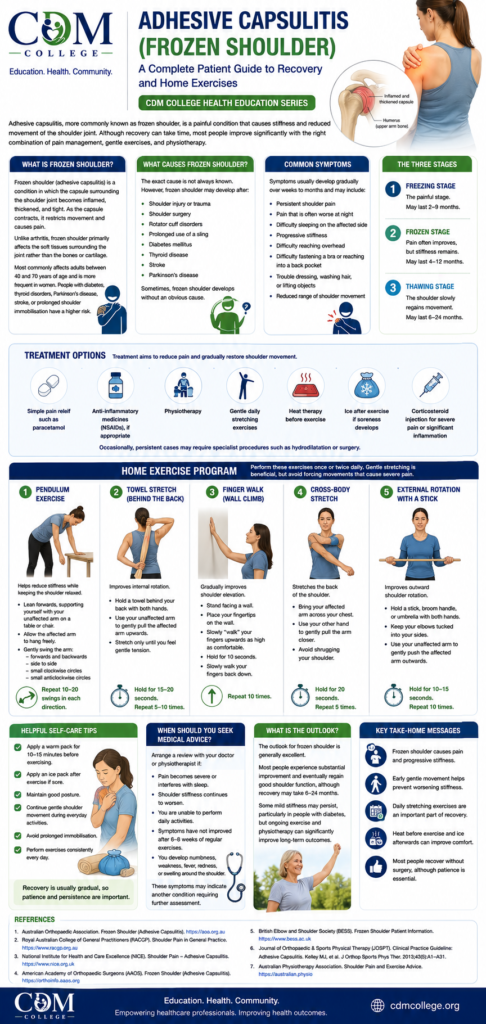
References
- Australian Orthopaedic Association. Frozen Shoulder (Adhesive Capsulitis). https://aoa.org.au
- Royal Australian College of General Practitioners (RACGP). Shoulder Pain in General Practice. https://www.racgp.org.au
- National Institute for Health and Care Excellence (NICE). Shoulder Pain – Adhesive Capsulitis. https://www.nice.org.uk
- American Academy of Orthopaedic Surgeons (AAOS). Frozen Shoulder (Adhesive Capsulitis). https://orthoinfo.aaos.org
- British Elbow and Shoulder Society (BESS). Frozen Shoulder Patient Information. https://www.bess.ac.uk
- Journal of Orthopaedic & Sports Physical Therapy (JOSPT). Clinical Practice Guideline: Adhesive Capsulitis. Kelley MJ, et al. J Orthop Sports Phys Ther. 2013;43(5)–A31.
- Australian Physiotherapy Association. Shoulder Pain and Exercise Advice. https://australian.physio
Help Shape the Future of Healthcare
Your donation enables CDM College to educate healthcare professionals, develop evidence-based learning, support scholarships, and improve the quality of chronic disease care for communities worldwide.
❤️ Donate Securely
Leave a Reply